+86-510-88156399



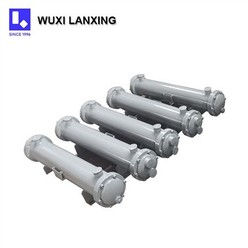
Shell and Tube Exchangers are composed of shell, heat transfer tube bundle, tube sheet, baffle plate (baffle plate) and tube box. The shell is mostly cylindrical with a tube bundle inside, and both ends of the tube bundle are fixed on the tube plate. The fluid flowing in the tube is cold and hot, called the tube side fluid; the other flowing outside the tube is called the shell side fluid. In order to improve the heat transfer coefficient of the fluid outside the tube, several baffles are usually installed in the shell.
Send InquiryChat NowIntroduction
Shell and Tube Exchangers are composed of shell, heat transfer tube bundle, tube sheet, baffle plate (baffle plate) and tube box. The shell is mostly cylindrical with a tube bundle inside, and both ends of the tube bundle are fixed on the tube plate. The fluid flowing in the tube is cold and hot, called the tube side fluid; the other flowing outside the tube is called the shell side fluid. In order to improve the heat transfer coefficient of the fluid outside the tube, several baffles are usually installed in the shell. The baffle can increase the velocity of the fluid in the shell side, forcing the fluid to pass through the tube bundle multiple times at a specified distance, and enhancing the turbulence of the fluid. The heat exchange tubes can be arranged in an equilateral triangle or square on the tube plate. The equilateral triangle arrangement is relatively compact, the fluid outside the tube has a high degree of turbulence, and the heat transfer coefficient is large; the square arrangement is convenient for cleaning outside the tube and is suitable for fluids that are easy to scale.

Product Components
1. Tube Sheet: A critical pressure-bearing component that secures the tube bundle and separates the tube side from the shell side.
2. Baffles: Guide the shell-side fluid to repeatedly laterally scour the tube bundle, enhancing turbulence, improving heat transfer efficiency, and supporting the tube bundle to prevent vibration.
3. End Caps/Tube Boxes: Distribute the tube-side fluid and can be designed to be removable for inspection and cleaning.
4. Expansion Joints: (For fixed tube sheet types) Used to compensate for differences in thermal expansion between the tube bundle and the shell due to temperature variations.

Feature
1. Structural Design:
The basic structure of Shell and Tube Exchangers consists of a cylindrical shell and an internal set of parallel pipes. Fluids flow through these pipes, exchanging heat between the fluids.
2. High Efficiency:
This heat exchanger has a large heat exchange area, enabling highly efficient heat exchange and is suitable for high-temperature and high-pressure conditions.
3. Wide Applicability:
It can be used in various industries, such as chemical, petroleum, pharmaceutical, and food processing, and is suitable for handling various media including gases, liquids, and steam.
4. Corrosion Resistance:
Depending on the working environment and the properties of the media, the heat exchanger can be made of different materials, such as stainless steel and titanium alloys, to improve corrosion resistance and service life.
5. Easy Maintenance:
The piping can be disassembled individually for easy cleaning and maintenance, ensuring long-term efficient operation of the equipment.
Application Areas
1. Chemical Industry: Used for reactor cooling and heating.
2. Petroleum Refining: Plays a crucial role in the heat exchange process of crude oil fractions.
3. Power Industry: Used for cooling water systems and generator thermal management.
4. Food and Beverage: Used for heat recovery and product cooling in dairy and beer production.
Selection Considerations
When selecting Shell and Tube Exchangers, the following factors need to be considered:
1. Fluid Properties: Understand the fluid's temperature, pressure, corrosiveness, and other characteristics.
2. Heat Exchange Efficiency: Select the appropriate heat exchanger size and configuration based on process requirements.
3. Installation Space: Ensure the equipment can be installed and maintained in the designated location.
4. Cost: Consider both initial investment and long-term operation and maintenance costs.
Maintenance Points
1. Regularly inspect seals and tube bundles for corrosion.
2. Monitor temperature and pressure parameters and assess performance degradation.
3. Remove scale using chemical cleaning or high-pressure water jetting.
4. For removable designs, perform scheduled core-pulling inspections of the tube bundle.

Our advantage
1. Pressure vessel product customization service
2. Pressure vessel manufacturer, ISO9001 quality management system
3. Familiar with foreign pressure vessel specifications, with American ASME, EU PED pressure vessel design and manufacturing qualifications, Japanese JIS, Malaysian DOSH vessels successfully delivered
4. Operation experience of professional foreign trade export projects
Hot Tags: shell and tube exchangers, China shell and tube exchangers manufacturers, suppliers, factory, heat exchanger for coolant coolers, multipass shell and tube heat exchanger, heat exchanger for hydrofluorocarbon refrigeration, shell and tube heat exchanger project, plate heat exchanger gaskets, air source heat exchanger
Professional manufacturer of pressure vessels and heat exchangers, Wuxi LanXing Pressure Vessel Co., Ltd. is located in Wuxi city, eastern China.


Tel: +86-510-88156399
Mob1: +8615852701809
Mob2: +8615951506886
Mob3: +8615952470757
Email: Zyc@cn-lxjt.com
Add: No.19, Feng Er Road, Xinwu District, Wuxi City, Jiangsu Province, China
Copyright © Wuxi Lanxing Pressure Vessel Co., Ltd. All Rights Reserved.Privacy Policy