+86-510-88156399




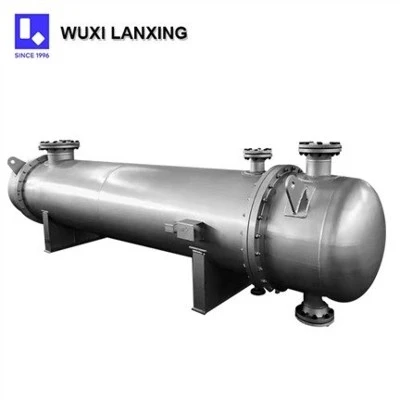
A Shell and Tube Heat Exchanger is an industrial heat transfer device consisting primarily of a cylindrical shell, a bundle of heat transfer tubes, tube sheets, heads, and process connections.
Send InquiryChat NowCustom Petrochemical Shell and Tube Heat Exchanger Manufacturer
LanXing manufactures customized Shell and Tube Heat Exchangers for the Petrochemical Industry, engineered for demanding heating, cooling, condensation, evaporation, and heat recovery applications. Designed for continuous industrial operation, our Petrochemical Heat Exchangers can be configured for high pressure, elevated temperature, corrosive process media, and strict process requirements.

A Shell and Tube Heat Exchanger is an industrial heat transfer device consisting primarily of a cylindrical shell, a bundle of heat transfer tubes, tube sheets, heads, and process connections.
One fluid flows through the tubes while another fluid flows around the outside of the tubes inside the shell. Heat passes through the tube walls without the two fluids directly mixing.
This configuration makes the shell and tube design particularly suitable for the petrochemical industry, where process streams frequently need to be heated, cooled, condensed, or recovered under controlled pressure and temperature conditions.
Depending on the application, either process fluid can be assigned to the tube side or shell side. Engineers select the appropriate arrangement according to pressure, temperature, corrosion, flow velocity, fouling characteristics, and maintenance requirements.
Working Principle
Tube Side
One process fluid enters the tube side through the inlet nozzle and flows through the heat transfer tubes.
Shell Side
The second process fluid enters the shell and flows across the external surface of the tubes. Baffles can be installed inside the shell to control the flow path and increase turbulence.
Heat Transfer
If the tube-side fluid is hotter than the shell-side fluid, thermal energy transfers through the tube wall from the hot fluid to the cold fluid.
The exact specifications of a Petrochemical Shell and Tube Heat Exchanger should be calculated according to the customer's process data.
| Parameter | Typical Specification |
|---|---|
| Equipment Type | Shell and Tube Heat Exchanger |
| Application | Heating / Cooling / Condensing / Evaporating / Heat Recovery |
| Heat Transfer Area | Customized |
| Heat Duty | Customized according to process requirements |
| Shell Material | Carbon Steel / Stainless Steel / Alloy Steel |
| Tube Material | SS304/304L / SS316/316L / Duplex / Titanium / Alloy |
| Tube Diameter | Customized |
| Tube Length | Customized |
| Number of Tubes | Calculated according to heat duty |
| Tube Arrangement | Triangular / Square / Rotated Square |
| Tube Passes | 1 / 2 / 4 / Multiple Passes |
| Shell Passes | Single or Multiple |
| Design Pressure | Customized |
| Operating Pressure | Customer Specified |
| Design Temperature | Customized |
| Operating Temperature | Customer Specified |
| Flow Rate | Customer Specified |
| Allowable Pressure Drop | Customized |
| Connection | Flanged / Welded / Customized |
| Orientation | Horizontal / Vertical |
| Baffle Type | Segmental / Other Customized Designs |
| Tube-to-Tubesheet Joint | Expanded / Welded / Expanded & Welded |
| Testing | Hydrostatic / Leakage / NDT |
| Design Standards | ASME / GB / JIS / Other Applicable Standards |
Note: Final specifications should not be selected solely from a standard table. LanXing's engineering team determines the final equipment dimensions and configuration based on thermal calculations, mechanical calculations, process conditions, and applicable codes.
Crude Oil Preheating
Shell and tube heat exchangers can recover heat from hot process streams and use it to preheat crude oil before subsequent processing.
This reduces the amount of external energy required for heating and can improve overall refinery energy efficiency.
Process Stream Cooling
Petrochemical process streams may leave reactors or processing equipment at elevated temperatures. A heat exchanger can transfer excess heat to cooling water, air coolers, thermal oil, or another process stream.
Condensation
Shell and tube equipment can be designed as condensers for converting process vapor into liquid.
Typical applications include hydrocarbon vapor condensation and recovery of valuable process fluids.
Feed Preheating
Feed streams can be preheated using recovered heat from outgoing process streams. This heat integration strategy can help reduce fuel consumption.
Reboiler Systems
A shell and tube configuration can also be engineered as a reboiler for distillation and separation processes.
The heating medium supplies thermal energy to vaporize part of the process fluid.
Gas Processing
In natural gas and petrochemical facilities, heat exchangers are used for gas cooling, heating, condensation, and temperature control.
High Heat Transfer Efficiency
Proper tube arrangement and shell-side flow control can increase turbulence and improve heat transfer performance.
High Pressure Resistance
The pressure-bearing components are mechanically designed according to the required design pressure and applicable code.
High Temperature Capability
Appropriate materials, welding procedures, and thermal design allow the equipment to operate under elevated-temperature conditions.
Large Heat Transfer Capacity
Shell and tube equipment can be scaled to accommodate large process heat duties required by petrochemical plants.
Corrosion Resistance
Stainless steel, duplex, titanium, and special alloys can be selected according to process conditions.
Flexible Configuration
Tube passes, shell passes, tube diameter, tube length, baffle arrangement, and nozzle configuration can be customized.
Easy Inspection and Maintenance
Depending on the configuration, removable tube bundles, access covers, manways, and inspection ports can facilitate maintenance.
Long Service Life
Correct material selection, engineering design, welding quality, and preventive maintenance contribute to long-term equipment reliability.
Q: What is a Shell and Tube Heat Exchanger used for in petrochemical plants?
A: It is commonly used for process heating, cooling, condensation, evaporation, feed preheating, reboiling, and heat recovery.
Q: Can the heat exchanger operate at high pressure?
A: Yes. The equipment can be engineered for high-pressure service according to the required design pressure and applicable standards.
Q: Can it be used at high temperatures?
A: Yes. Material selection and mechanical design can be customized for elevated-temperature applications.
Q: What materials are available?
A: Carbon steel, stainless steel, duplex stainless steel, titanium, and various alloy materials can be considered.
Q: Can the shell and tubes use different materials?
A: Yes. For example, a carbon steel shell can be combined with stainless steel tubes when the process conditions require different material properties.
Q: How is the heat transfer area determined?
A: The required area is calculated based on heat duty, fluid properties, flow rates, inlet/outlet temperatures, heat transfer coefficient, fouling resistance, and allowable pressure drop.
Q: What information should I send for a quotation?
A: Ideally provide fluid information, flow rates, inlet/outlet temperatures, operating/design pressures, operating/design temperatures, heat duty, allowable pressure drop, materials, and applicable standards.
Q: Can LanXing manufacture according to ASME?
A: Yes. LanXing can design and manufacture applicable pressure equipment according to ASME requirements, subject to the specific project and certification scope.
Q: Do you provide customized nozzle arrangements?
A: Yes. Nozzle size, quantity, orientation, and connection type can be customized according to the customer's piping layout.
Q: Can you provide third-party inspection?
A: Third-party inspection can be arranged according to project requirements.
Hot Tags: shell and tube heat exchanger used for petrochemical industry, China shell and tube heat exchanger used for petrochemical industry manufacturers, suppliers, factory, bosch heat exchanger, regenerator and recuperator, heat exchanger for transonic applications, glass heat exchanger, heat exchanger for existing installation heat transfer, brazed plate heat exchanger
Professional manufacturer of pressure vessels and heat exchangers, Wuxi LanXing Pressure Vessel Co., Ltd. is located in Wuxi city, eastern China.


Tel: +86-510-88156399
Mob1: +8615852701809
Mob2: +8615951506886
Mob3: +8615952470757
Email: Zyc@cn-lxjt.com
Add: No.19, Feng Er Road, Xinwu District, Wuxi City, Jiangsu Province, China
Copyright © Wuxi Lanxing Pressure Vessel Co., Ltd. All Rights Reserved.Privacy Policy